Affiliate disclosure: TCGplayer, eBay, and Amazon links on this page are affiliate links. InkSight may earn a commission at no extra cost to you. As an Amazon Associate, InkSight earns from qualifying purchases. Nothing on this page is influenced by affiliate revenue.
Three weeks is the first honest checkpoint for a Lorcana set. The prerelease weekend distorts everything before it: listings are sparse, sellers price on hope, and a single optimistic ask can drag a Market average around. By day nineteen the box-cracking wave has passed, supply has landed on shelves, and the prices you see are being set by people who own the cards rather than people who are guessing about them.
So this is a review of what actually happened to Attack of the Vine! prices between July 24 and August 11 — the top of the set, the middle of the set, and the sealed product that feeds both. Nothing here is a forecast. It is a record.
The three-week picture, in one chart
Indexing to launch removes the scale problem: a $3,000 Iconic and a $350 Enchanted can be compared on the same axis when both start at 100. Everything above the dashed line is worth more today than it was on release day.
Two things jump out. First, the Iconic tier front-loaded its correction — Lilo & Stitch did almost all of its falling in the first four days and has been flat since, while Belle & Beast bled down steadily across the whole window. Second, one Enchanted broke the pattern entirely and climbed the whole way up.
The Iconics: a launch premium that did not hold
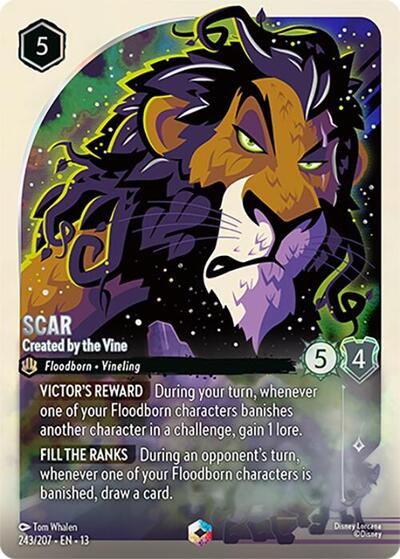
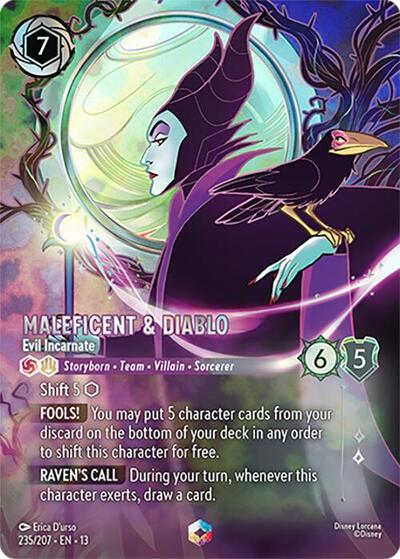
Both Set 13 Iconics opened at eye-watering numbers, and both are meaningfully cheaper today. These are the two most expensive cards in the set by a wide margin, and they are also the two thinnest markets in it — at four figures per copy, a handful of sales sets the print for everybody.
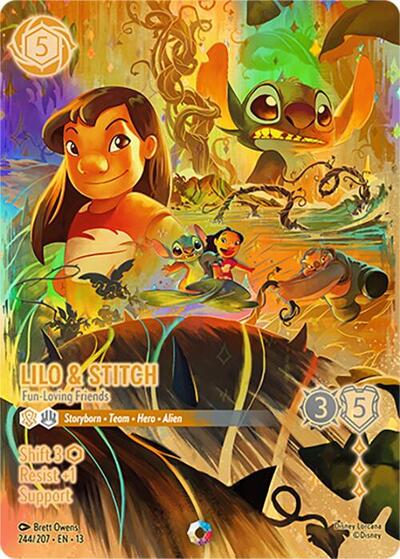
The Lilo & Stitch path is the more instructive one. Its July 24 Market of $3,000.00 was a launch-day artefact — a round number set by very few transactions. By July 28 it printed $1,662.87 and it has sat in a tight band ever since, closing at $1,681.59 on August 11. That is not a crash; that is a price discovering itself once real supply arrived.
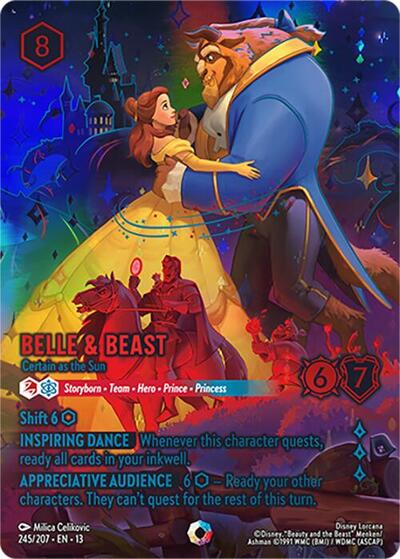
Belle & Beast behaved differently. It has declined in every week of the window — $2,984.33 to $2,673.75 to $2,349.53 to $2,188.63 — which reads less like discovery and more like a slow supply drip meeting patient buyers. It is now the most expensive card in the set, having started as the cheaper of the two.
Honesty note: we would not treat either Iconic print as a precise valuation. Both are thin markets, and InkSight flags cards where the Lowest Ask sits more than 1.5× above Market as thin. Use these as a range, not a quote.
The Enchanteds that went up
Of the 18 Enchanted printings our feed carries for the set, 3 are worth more today than at launch and 15 are worth less. That ratio is normal for week three — most Enchanteds drift down as supply lands — which makes the exceptions worth naming.
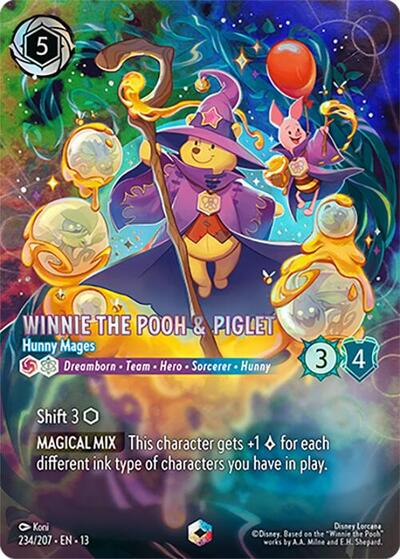
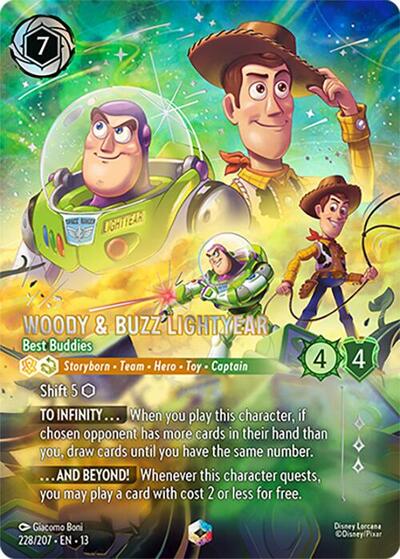
Pooh & Piglet — Hunny Mages is the story of the set. It opened at $653.66, and it has printed higher at every checkpoint since: $695.92, $790.97, $852.24, $891.06, and $916.11 on August 11. That is +40.2% in nineteen days, and it happened without a single down week in our snapshots. It is now the third most valuable card in Attack of the Vine!, behind only the two Iconics, and it has pulled clear of Woody & Buzz, which opened well above it.
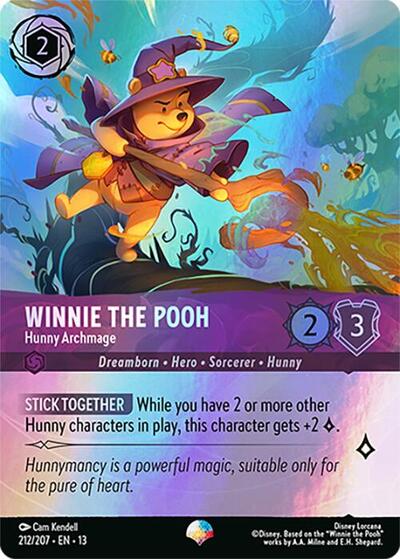
We are not going to pretend we know exactly why. Constructed demand around the Pooh package is the obvious candidate, and the card’s Epic-rarity sibling, Winnie the Pooh — Hunny Archmage, has held its own at $18.74 while most set commons decayed. What we can say is that the move is broad-based rather than one spike: six consecutive higher prints is a trend, not a sale.
The Enchanteds that gave ground
The declines are where the set’s launch enthusiasm shows up most clearly. Four Enchanteds have lost more than a quarter of their launch value, and the steepest one has almost halved.
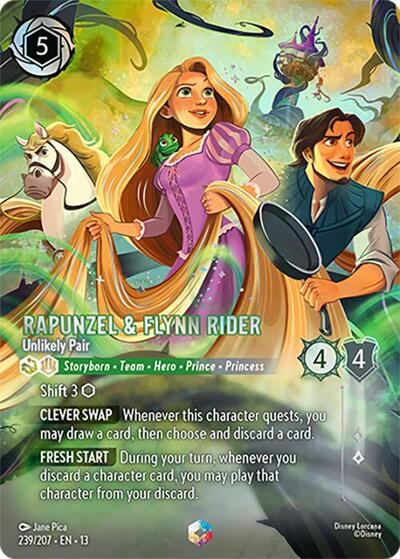
Rapunzel & Flynn Rider — Unlikely Pair is the mirror image of Pooh & Piglet: $353.55 at launch, then $289.13, $252.35, $219.63, $191.35, and $185.12 — six consecutive lower prints, −47.6% in total. A card that opened as a top-five Enchanted now sits mid-table. If you paid launch price for one, that is a real loss on paper; if you are buying, it is the clearest example in the set of why waiting three weeks is usually cheaper than buying on release day.
Across the whole Enchanted tier, the median printing went from $176.08 at launch to $153.74 on August 11 — a −12.7% move for the typical card. The tier is softening, but it is not falling apart.
Every Enchanted: launch vs today
Sorted by current Market price. Launch is the July 24, 2026 snapshot; current is August 11, 2026. Card names link through to TCGplayer.
Sealed: the quietest number on the page
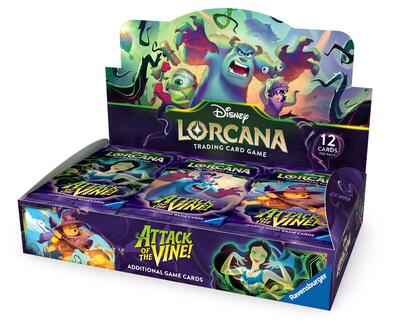
While singles moved in both directions, sealed Attack of the Vine! product has been remarkably stable — which is itself a finding. A booster box printed $203.73 Market on July 24 and $199.94 on August 11, a move of −1.9%. A case went from $853.50 to $838.51, −1.8%.
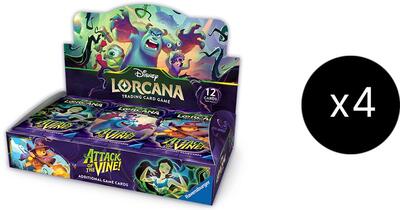
Flat sealed alongside a softening Enchanted tier means box EV has compressed slightly: you are paying the same for a box while the average chase inside it is worth a little less than it was on release day. That is the ordinary arc of a Lorcana set in its first month, and it is the reason we tell people that box math done on launch-week prices ages badly.
Lowest Ask vs Market: where the quoted price is not the price
Market price tells you what copies have been trading for. Lowest Ask tells you what the cheapest listed copy is asking today. On a liquid card the two sit close together; on a thin one they diverge, and the gap is the most useful honesty signal we have.
On the August 11, 2026 snapshot, Belle & Beast — Certain as the Sun showed a Lowest Ask of $2,049.00 against a Market of $2,188.63 — the cheapest listing is under the trailing average, which usually means the price is still working downward. Lilo & Stitch — Fun-Loving Friends did the opposite: Lowest Ask $1,740.00 against Market $1,681.59, so anyone buying today pays above what recent sales printed.
Neither gap is wide enough for us to flag the cards as thin — our threshold is a Lowest Ask more than 1.5× Market — but both are wide enough that quoting a single number for these cards would be misleading. Same story further down: Pooh & Piglet asked $944.99 against a $916.11 Market, and Rapunzel & Flynn Rider asked $160.00 against $185.12 — the cheapest copy is well below the average, which is consistent with a card still falling.
The practical version: on any Set 13 card above roughly $150, treat the number in this article as the centre of a range rather than a quote, and check the live listing spread before you act on it.
What three weeks actually tells you

A few things are safe to conclude from this window, and a few are not.
- Launch-day prices on four-figure cards are not valuations. Both Iconics printed a round, thin number on July 24 and both are materially cheaper now. That is the rule, not the exception.
- The correction is not uniform. 3 of 18 Enchanteds are up. Treating “Enchanteds always fall after release” as a law would have cost you the best-performing card in the set.
- Sealed decouples from singles early. Boxes moved −1.9% while individual chases moved by up to 48% in either direction.
- Three weeks is still early. Nineteen daily snapshots is enough to see direction; it is not enough to call a floor. Set 12 cards were still finding levels at week eight.
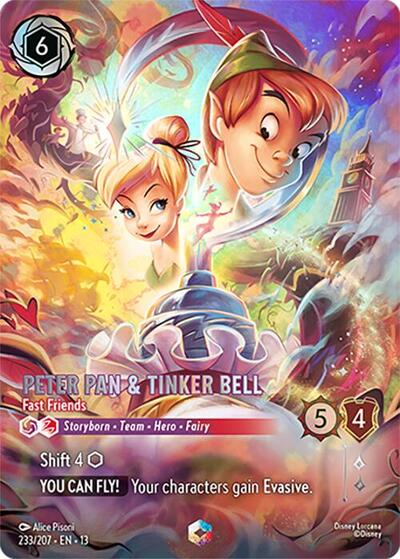
What we cannot tell you is where any of this lands. We do not publish price forecasts, because the honest answer for a three-week-old set is that supply is still arriving and the constructed metagame has not settled. Watch the direction of the weekly prints instead — six consecutive higher or lower snapshots, as with Pooh & Piglet and Rapunzel & Flynn, is the strongest signal available at this stage.
What we are watching next
Three specific things over the next month, all of which we will report either way:
- Whether Pooh & Piglet holds above $900. A card that rises this fast in three weeks usually gets tested. The August snapshots will show whether the buyers were players or speculators.
- Whether the Iconic pair stabilises. Lilo & Stitch has been flat for two weeks; Belle & Beast has not stopped falling. If Belle & Beast flattens near $2,100, the tier has probably found its level.
- Whether sealed holds $200. Box price is the cleanest read on whether the set is being opened or shelved.
If you own Set 13 cards, the fastest way to see your own version of this table is to add them to a collection on InkSight — the analytics tab prices every printing against the same daily snapshots used above, and flags thin markets rather than quoting them at you.
FAQ
Have Attack of the Vine prices gone down since release?
Mostly, but not universally. Between the July 24, 2026 launch snapshot and August 11, 2026, 15 of the 18 Enchanted printings we track were lower and 3 were higher, and both Iconics were substantially lower. The median Enchanted moved −12.7%.
What is the most valuable Attack of the Vine card right now?
By TCGplayer Market price on August 11, 2026, it is Belle & Beast — Certain as the Sun (Iconic) at $2,188.63, ahead of Lilo & Stitch — Fun-Loving Friends (Iconic) at $1,681.59. The most valuable Enchanted is Winnie the Pooh & Piglet — Hunny Mages at $916.11.
Which Attack of the Vine card has gained the most since release?
Winnie the Pooh & Piglet — Hunny Mages, up +40.2% from $653.66 on July 24 to $916.11 on August 11, 2026. It rose in every snapshot week of the window.
Is now a good time to buy Attack of the Vine singles?
We do not give buy or sell advice. What the data supports saying is that most of the set is cheaper than it was on release day, that four-figure cards are thin enough that the quoted price may not be achievable, and that sealed box prices have been stable for three weeks.
Where do these prices come from?
InkSight records a daily TCGplayer snapshot for every printing we track and stores the history. Every figure on this page is a Market price from that history — the July 24, 2026 and August 11, 2026 snapshots specifically. Read our methodology for how snapshots, confidence flags, and thin-market handling work.